Risk before optimisation
A fast, centralised route is tempting, but repeated use creates heat, pattern recognition and linked exposure.
Development is on hold. This page records the concept and intended roadmap.
A pausable real-time, isometric risk-management logistics game about building a covert trade network inside ordinary urban infrastructure.
The question is not simply how to build the most efficient route. It is whether the network can stay hidden for one more run.
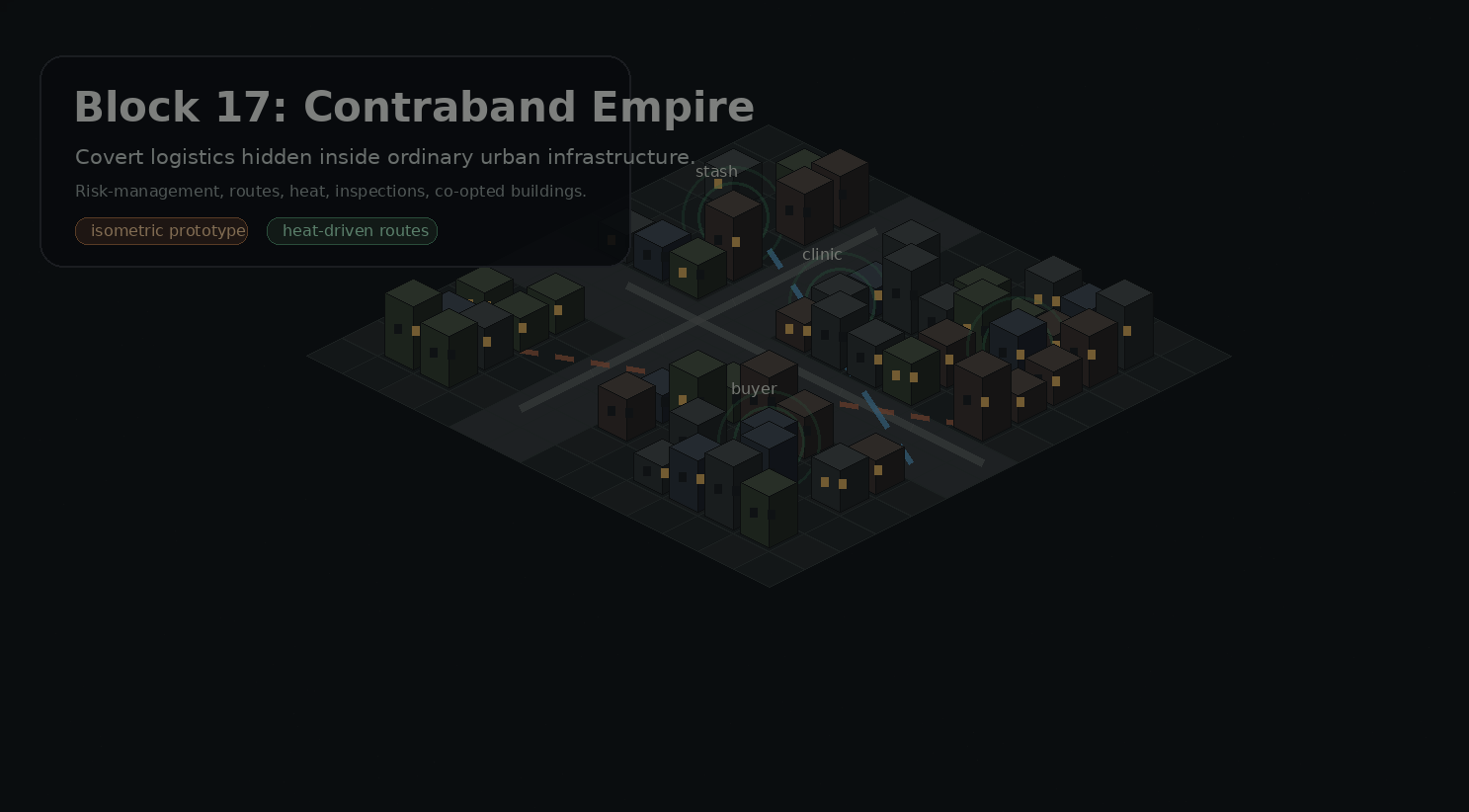
The player quietly co-opts terraced houses, garages, clinics, corner shops, workshops, warehouses, railway arches and ruined civic buildings. Ordinary-looking infrastructure becomes the hidden layer of a post-collapse economy.
A fast, centralised route is tempting, but repeated use creates heat, pattern recognition and linked exposure.
The player does not build obvious compounds. They hide processors, stashes and front businesses inside ordinary buildings.
A route moves from fresh to watched, flagged and eventually burned if the player squeezes it for too long.
Heat exists at route, segment, region, node, building and network level, but the player sees bands and trends rather than exact certainty.
A cleaner, more premium lock-up for a modern strategy game. The emphasis is industrial clarity, route logic, isometric urban massing and strong small-size readability.
Built for the website hero, trailer cards, pitch decks and Steam capsule exploration. The logo pushes the city-block and route-network idea without drifting into generic shooter branding.
Designed to hold up at launcher, library and social-card sizes. The large 17, dark block mass and amber routing make it immediately legible at a glance.
The page mock-up below is not a live game build. It is a website presentation layer for the current Block 17 design direction: dark isometric map, route overlays, heat states, building panels and inspection choices.
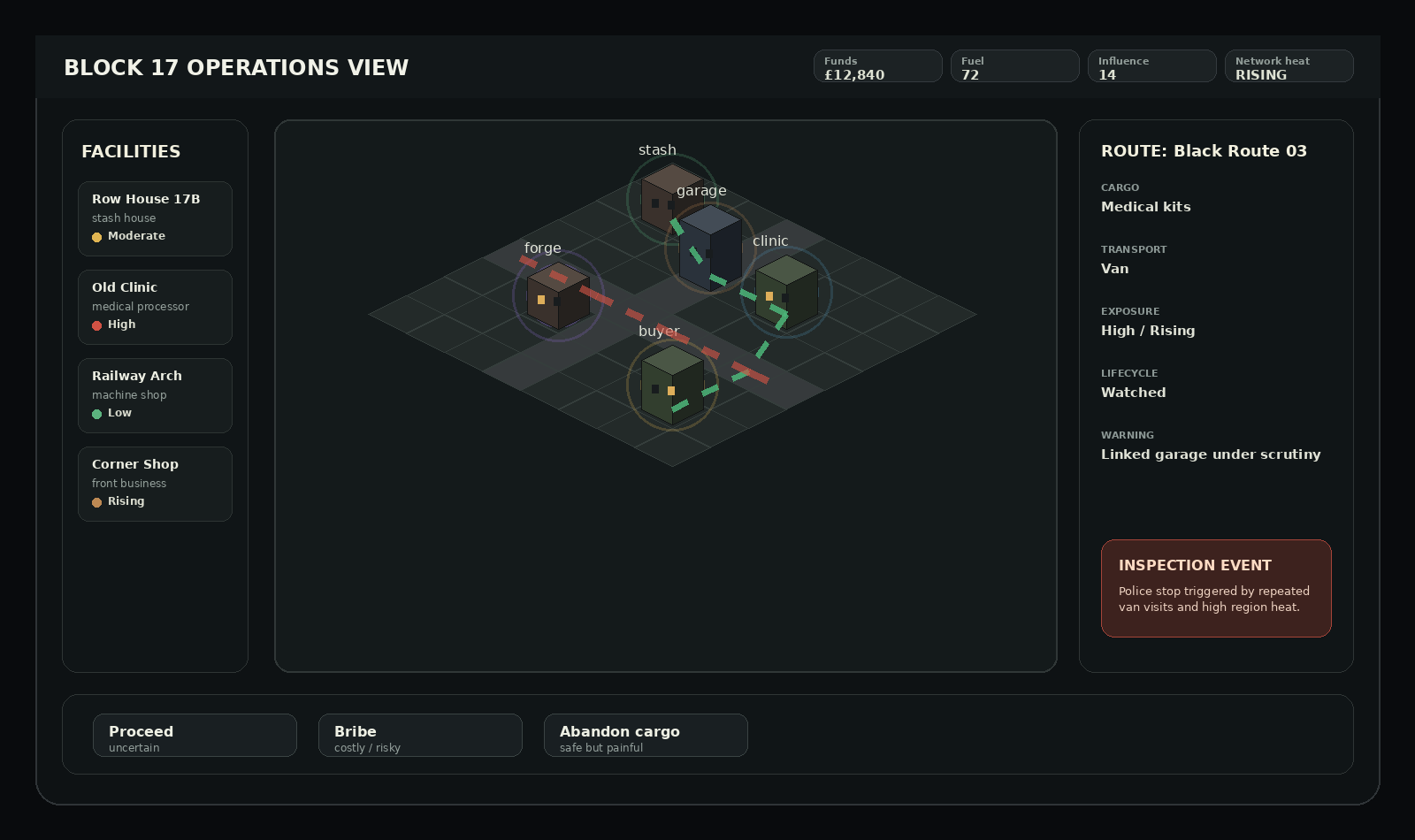
The project needs more than a good visual hook. The deeper appeal should come from the interaction between buildings, transport, markets, inspections, faction pressure and imperfect information.
Every site begins as an ordinary urban or peri-urban building. The player converts it into a stash, processor, safehouse, handover point or front business.
Routes combine buildings, transport type, cargo profile and timing. The best route today becomes the most obvious route tomorrow.
Heat accumulates through repetition, clustering, region visibility, cargo seriousness and linked exposure. Heat should spread, not just spike.
Traffic stops, raids, neighbour suspicion, faction demands, damaged shipments and courier unreliability force the player to react under uncertainty.
Primary goods feed secondary goods, and secondary goods feed tertiary high-value outputs. Higher margins usually mean sharper consequences.
The safest network is varied and redundant. Spare routes, decoys, cool-down periods and sacrificial buildings become meaningful strategy.
The design is built around interacting systems rather than a single production chain.
Primary goods are bulky and low-margin, secondary goods require hidden processing, and tertiary goods are high-value but high-consequence.
Urban ruins, industrial zones, residential blocks, wilderness corridors, border checkpoints and faction territories change risk and reward.
Routes move through fresh, used, watched, flagged and burned states. The safest route is often the one stopped before it collapses.
Inspections turn abstract heat into consequence: delays, cargo loss, route flags, building suspicion, raids and linked exposure.
A small website toy for the game page. It is not the actual game logic, but it shows the design philosophy: heat comes from repeated use, cargo profile, route density, region risk and transport visibility.
Repeated van movement through urban ruins is creating a visible pattern. Rotate route, split cargo or add a safer handover node.
The strongest publishing route is probably not to wait for a mythical perfect 1.0. A disciplined vertical slice followed by wishlist-building, public visibility and a targeted Steam Early Access launch makes more sense if the core loop is genuinely strong.
Lock the visual language, camera, input model, district scale, building categories, cargo categories, route objects and heat model. Define the minimum viable contraband chain and the first inspection event set.
Build one playable district with co-optable buildings, route drafting, time control, heat accumulation, one courier type, one van type, one processor type and a working inspection outcome loop.
Test whether the risk loop is actually interesting. Focus on readability, decision pressure, route feedback, map clarity, consequence pacing and whether diversity really beats brute efficiency.
Open the Steam page once the visual identity, screenshots, logo, icon, trailer framing and core pitch are strong. Start collecting wishlists using the vertical slice, devlogs and short system explainers.
Create a sharply bounded demo with one district, a short progression arc, a couple of contraband chains and enough event variety to prove the concept without exhausting content too early.
Launch once the district loop is robust, save/load is solid, the UI is readable and the heat system consistently produces tension. Early Access should expand districts, contraband variety, factions, personnel and event depth.
Use player data and feedback to tune risk, route decay, building value, event frequency and progression. Add more district types, logistics options, contraband chains and emergent complications.
Push to a stronger final structure with campaign framing, deeper systems, improved onboarding, better AI or faction pressure, a broader map and a polished content baseline that justifies the full release.
The design is systemic and balance-sensitive. It should benefit from real player pressure long before a final release. If the route-and-heat loop is compelling, Early Access becomes a way to harden the design rather than a way to excuse unfinished thinking.